Key Facts: Greece Wages
- Country
- Greece (GRC)
- Continent
- Europe
- Currency
- Euro (EUR)
- Minimum Wage
- €5.31 /hr ($5.96 USD)
- Average Gross Monthly Salary
- €1,400 /month
- Average Gross Annual Salary
- €19,600 /year
- Median Individual Income
- €12,800 /year
- Standard Work Week
- 40 hours
- Data Source
- Ministry of Labour and Social Security (Υπουργείο Εργασίας και Κοινωνικής Ασφάλισης); 2026 figure verified via Wikipedia EU member states by minimum wage table (eff 2026-04-01)
- Last Updated
- 2026-05-04
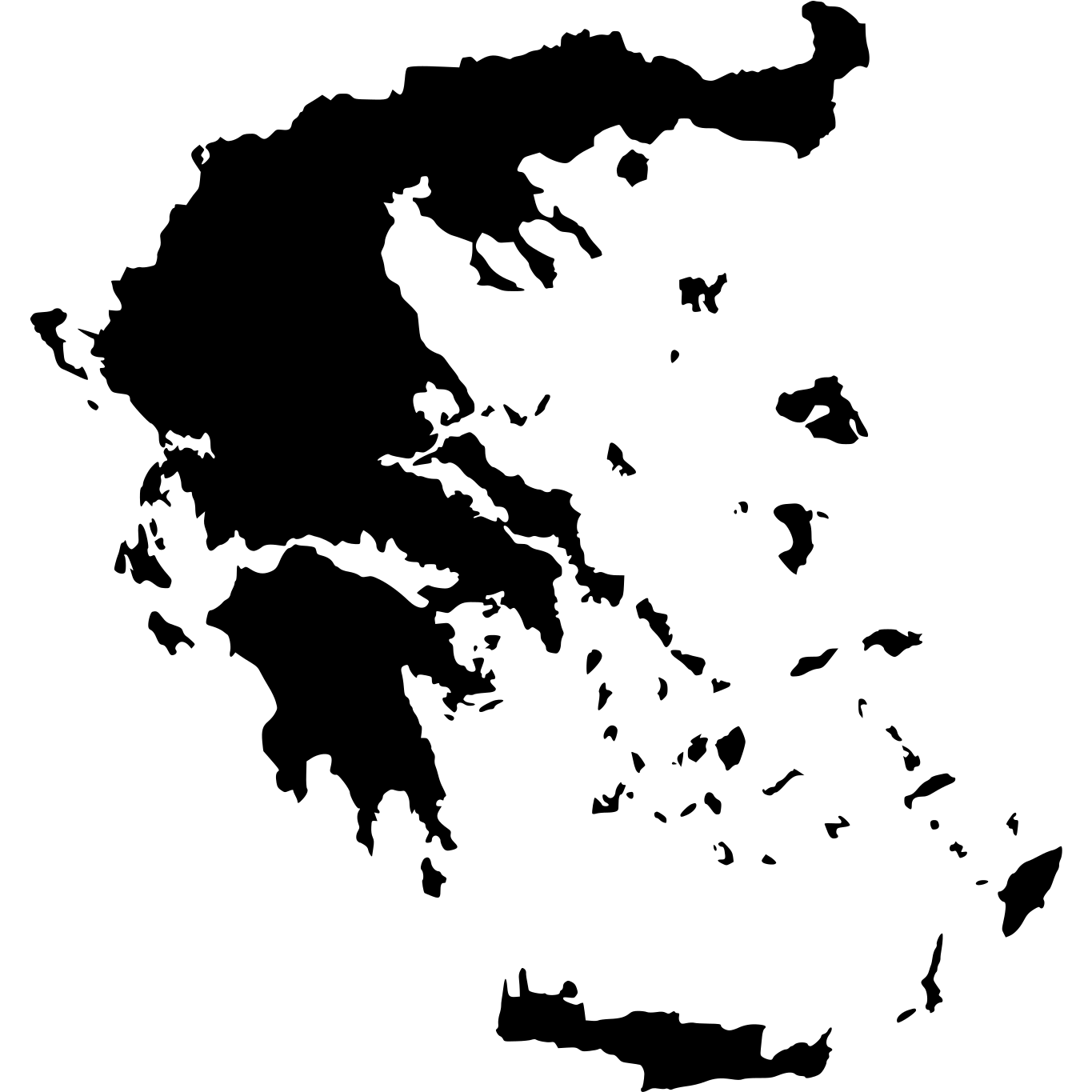

Greece — Average Salary & Wages
Euro (EUR) Data verified Jan 2026 Sources
The average salary in Greece is
€19,600 a year
But half of all workers earn less than €12,800 .
The average is lifted by bonuses and high earners. Most workers earn less than that.
The minimum wage in Greece is €5.31/hr ($5.96 USD) as of 2026. The average gross monthly salary is €1,400 ($1,571.44 USD). The median monthly income is €1,066.67 ($1,197.29 USD).
The Numbers
Greece's minimum wage is near the median for Europe, ranking #24 out of 40 countries with statutory minimum wages. Over the past 14 years, the minimum wage has increased by 57% in nominal terms. The standard work week is 40 hours.
Average gross monthly earnings for full-time employees. Annual includes 14 payments. Net estimated after income tax and social security contributions (13.87% employee rate). Greece uses a progressive income tax system with rates from 9% to 44%.
About the Greece economy
Greece is a member of the European Union and the eurozone, and its economy has recovered from the 2009 to 2018 sovereign debt crisis. Services dominate output at 68 percent of GDP, with industry at 15.4 percent and agriculture at 3.3 percent (OpenFactBook, 2024 est.). Tourism, food and tobacco processing, textiles, chemicals, metal products, mining, and petroleum lead the industrial base, and Greece operates one of the world's largest merchant fleets. Leading exports include refined petroleum, packaged medicine, aluminum, olive oil, and tobacco. Italy is the top trading partner at 12 percent of exports, followed by Germany and Cyprus each at 6 percent, and Bulgaria and the United States each at 4 percent. Real GDP grew 2.3 percent in 2024, above the eurozone average, while public debt remained at 190.6 percent of GDP in 2023.
The labor force totals 4.655 million people as of 2024. Unemployment fell to 8.5 percent in 2025, down from a crisis peak above 27 percent in the mid-2010s. Youth unemployment remains elevated at 24.7 percent for workers aged 15 to 24. Greece has the third-oldest population in the EU, with 23.6 percent aged 65 or older. The crisis years drove substantial emigration of skilled workers, and informal employment continues to account for a meaningful share of activity.
Wages in Greece were compressed during the bailout period, when statutory minimums and collective agreements were cut as conditions of EU and IMF financing. The minimum wage has risen in successive steps since 2019. The current statutory floor of €920 per month gross applies. Greece pays statutory wages 14 times per year, with extra installments at Christmas, Easter, and summer leave, so the headline monthly figure understates annual gross pay relative to 12-payment countries. Implementation of the EU Adequate Minimum Wages Directive continues to shape future adjustments.
Wage Breakdown
- Hourly
- €5.31
- Monthly
- €920Gross monthly minimum for 14 payments/year. 12-payment equivalent is €1,073.33/month.
- Annual
- €12,880€920/month x 14 payments/year (includes holiday and Christmas bonuses)
2026 rate of €920/month (14-pay basis; €1,073.33/mo on 12-pay basis) effective April 1 (10.8% increase from 2025's €830). Greece's minimum wage is set by government decision following consultation with social partners and the Centre of Planning and Economic Research (KEPE). Greece pays 14 monthly installments: 12 regular months plus a half-month Christmas bonus, a half-month Easter bonus, and a half-month summer holiday bonus (totaling 14 months). Hourly rate calculated based on 40 hrs/week and 173.33 hrs/month. The sub-minimum rate for workers under 25 was abolished in 2019.
What It Buys
• PPP ADJUSTED
In Greece, the minimum wage has the purchasing power of $10.21/hr in the United States, adjusted for local cost of living using the World Bank PPP conversion factor.
Medical coverage for remote workers in Greece and beyond
Nomad Insurance is built for people living and working outside their home country. Sign up from anywhere, including after you have already left home. It covers unexpected medical treatment, hospitalization, and common travel incidents across 180+ countries, paid by 4-week subscription rather than an annual policy.
Affiliate link: wage.is may earn a commission if you sign up, at no extra cost to you.
See current Nomad Insurance pricing →In Context
At minimum wage, a full-time worker in Greece earns €920/mo. That is 66% of the average gross salary.
- Monthly (full-time)
- €920 at min. wage
- Share of avg. salary
- 66% gross, before tax
- USD equivalent
- $1,032.66/mo monthly
- Nominal growth
- +57% since 2012
How It Changed
Minimum Wage Trend
Since 2012, the minimum wage has grown +57% in nominal terms.
Where It Varies
Work Week
- Standard
- 40 hrs/wk
- Maximum
- 48 hrs/wk
- Overtime
- 1.2x pay
Standard workweek is 40 hours across 5 days (Labour Law). Overtime beyond 40 hours is compensated at 120% for the first 5 hours per week and 140% thereafter. In 2024, Greece introduced optional 6-day workweek legislation for certain industries, with the 6th day paid at 140%. EU Working Time Directive limits average to 48 hrs/week.
How It Compares
How Greece Compares
| Metric | Greece | Europe Avg. | Europe Highest |
|---|---|---|---|
| Min. wage (USD equiv.) | $5.96/hr | $8.34/hr | $17.94/hr (Jersey) |
| Avg. salary (USD equiv.) | $1,571.44/mo | $3,184.98/mo | $9,436.24/mo (Switzerland) |
Countries with Similar Minimum Wages
| Country | Min. Wage /hr (USD) |
|---|---|
| Portugal | $5.96 |
| Anguilla | $6.00 |
| Slovakia | $5.90 |
| Saint Helena, Ascension and Tristan da Cunha | $6.06 |
| Sint Maarten | $6.11 |
| Greece | $5.96 |
Related Wage Comparisons
• NEIGHBORING COUNTRIES

Compare Greece
 Germany
  United Kingdom
  France
  Russia
  United States
  Japan
Japan Popular Comparisons
Germany United Kingdom France Russia  Netherlands
  Turkey
  Switzerland
  Poland United States
  China
China  India Japan
  South Korea
  Canada
  Australia
 More in Europe
 Åland Islands
  Andorra
  Austria
  Belarus
  Belgium
 Frequently Asked Questions
What is the minimum wage in Greece?
The minimum wage in Greece is €5.31/hr (approximately $5.96 USD), effective since 2026-04-01. 2026 rate of €920/month (14-pay basis; €1,073.33/mo on 12-pay basis) effective April 1 (10.8% increase from 2025's €830). Greece's minimum wage is set by government decision following consultation with social partners and the Centre of Planning and Economic Research (KEPE). Greece pays 14 monthly installments: 12 regular months plus a half-month Christmas bonus, a half-month Easter bonus, and a half-month summer holiday bonus (totaling 14 months). Hourly rate calculated based on 40 hrs/week and 173.33 hrs/month. The sub-minimum rate for workers under 25 was abolished in 2019.
What is the average salary in Greece?
The average gross monthly salary in Greece is €1,400 (approximately $1,571.44 USD). Average gross monthly earnings for full-time employees. Annual includes 14 payments. Net estimated after income tax and social security contributions (13.87% employee rate). Greece uses a progressive income tax system with rates from 9% to 44%. Source: Hellenic Statistical Authority (ELSTAT) (2025).
How many hours is the standard work week in Greece?
The standard work week in Greece is 40 hours, with a legal maximum of 48 hours. Overtime is paid at 1.2x the normal rate. Standard workweek is 40 hours across 5 days (Labour Law). Overtime beyond 40 hours is compensated at 120% for the first 5 hours per week and 140% thereafter. In 2024, Greece introduced optional 6-day workweek legislation for certain industries, with the 6th day paid at 140%. EU Working Time Directive limits average to 48 hrs/week.
How has the minimum wage in Greece changed over time?
The minimum wage in Greece has changed as follows: €586.08 in 2012, €650 in 2019, €713 in 2022, €780 in 2023, €780 in 2024, €830 in 2025, €920 in 2026. This represents 7 recorded adjustments.
What is the minimum wage in Greece in USD?
The minimum wage in Greece converts to approximately $5.96/hr in US dollars, based on current exchange rates. Actual purchasing power may differ due to local cost of living.
What is the average salary in Greece in USD?
The average gross monthly salary in Greece is approximately $1,571.44 per month in US dollars, based on current exchange rates. Actual purchasing power may differ due to local cost of living.
How does Greece's minimum wage compare to the Europe average?
Greece's minimum wage ranks #24 out of 40 countries with statutory minimum wages in Europe, placing it near the median for Europe.
From Insights
All Insights →In-depth wage analysis and data stories from wage.is Insights.